Learn how LLDP (Link Layer Discovery Protocol) enhances PoE systems through intelligent power negotiation, efficient energy management, and device discovery in modern Ethernet networks.
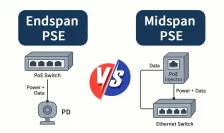
Learn the difference between PSE and PD in PoE networks, how detection & classification work, and which LINK-PP PoE RJ45 products suit your WAP, camera or VoIP deployment.
Learn what a Powered Device (PD) is in PoE networks, how it receives power from a PSE, and explore LINK-PP’s PoE-ready components like LPJK6072AONL and LP41223NL.
Power consumption optimization for optical transceivers in edge computing reduces energy use, lowers costs, and boosts network scalability and reliability.
Discover the IEEE 802.3at (PoE+) standard, its 30W power delivery, key applications, and benefits. Learn how LINK-PP PoE+ RJ45 Magnetics support modern networks.
NG-PON2 delivers faster, more reliable fiber optic internet with higher capacity, supporting up to 256 users and 40 Gbit/s speeds for homes and businesses.
10G-EPON delivers up to 10Gbps internet, higher bandwidth, and reliable performance for homes and businesses needing fast, efficient fiber connectivity.
Discover what cloud storage is, how it works, and why businesses rely on it for secure, scalable data management. Learn real-world applications and solutions.
Learn the differences between Big Data and Traditional Data, including scale, speed, complexity, and infrastructure needs. Discover how optical modules enable modern Big Data workloads.
exploring cloud migration and its benefits, strategies, best practices, also delve into the essential hardware, like optical modules, that make it all possible.
Learn what the PCS (Physical Coding Sublayer) is, how it enables reliable Ethernet transmission, and why it matters for high-speed optical transceivers and network design.
Physical Medium Dependent (PMD) defines the optical and electrical rules of a PHY—wavelength, power, reach, and test points. Understand PMD specs and how they guide transceiver selection.
Learn what the PMA (Physical Medium Attachment) is, how it handles serialization and clock recovery, and why it is essential for modern high-speed optical transceivers.
Master Mean Time to Acknowledge (MTTA), the key metric for rapid response. Learn its role in system availability, how to calculate it, and proven steps to reduce MTTA for superior network uptime.
Master Mean Time to Detect (MTTD), the most crucial metric for avoiding silent failures. Learn the calculation, its role in modern observability, and how to reduce MTTD for superior system availability.
Discover MTBF (Mean Time Between Failures), its importance for system reliability, and how LINK‑PP industrial connectors and SFP/SFP+ modules help maximize uptime.
A clear, professional guide to IIoT (Industrial Internet of Things), covering architecture, protocols, security best practices, and suitable networking components for industrial deployments.
Learn what MTTR (Mean Time to Repair) means, why it matters for system reliability, and how LINK‑PP’s hot-swappable SFP/SFP+ transceivers reduce repair time.
Discover the LQ‑SW40‑SR4C 40GBASE‑SR module: high-speed, low-power, QSFP+ optics for multimode fibre networks. Perfect for data centres and network upgrades.
Learn what hyperconverged infrastructure HCI is, how it compares with virtualization and dHCI, and when Nutanix, Sangfor, or SFP-based designs fit best.
Understand SFP+ 40km (10GBASE-ER) modules, including specs, SMF compatibility, and how to choose the right extended-reach optical transceiver for your network.