A router ONU combines signal conversion and network routing for fiber-optic internet, letting you connect multiple devices to fast, reliable service at home.
Explore the world of resistors with our in-depth guide. Learn about different types, their applications, and specifications to make informed decisions for your electronic projects.
Discover what an inductor is, how it functions in electronic circuits, its types, and real-world applications. Learn about this essential component in modern electronics.
Explore the fundamental differences between GPUs and CPUs, their architectural distinctions, and performance benchmarks to understand which processor suits your computing needs.
Explore how Data Processing Units (DPUs) optimize data center performance, accelerating networking, storage, and security. Discover LINK-PP optical modules for high-speed interconnects.
Learn the difference between MTTR and MTBF, how they impact system reliability, and how LINK-PP industrial connectors and SFP/SFP+ modules help improve network uptime.
Optical networking delivers high speed, security, and scalability for private and hybrid cloud deployments, ensuring reliable and efficient data connectivity.
Signal integrity and low latency in data center transceivers ensure reliable, error-free data transmission and optimal performance for real-time applications.
Learn how industrial IPCs use LINK-PP SFP/SFP+ cages to build high-speed, EMI-protected fiber uplinks for PLCs and edge networks. Ideal for Industry 4.0 and smart factories.
Explore how an Industrial PC (IPC) reliably communicates with a PLC using LINK-PP integrated RJ45 connectors for robust isolation and EMI resilience in industrial Ethernet networks.
Power Over Ethernet (PoE) combines power and data delivery via a single cable, simplifying installations for devices like IP cameras, VoIP phones, and IoT systems.
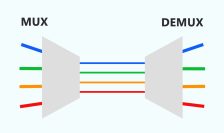
Wavelength Division Multiplexing (WDM) uses optical transceiver modules to send multiple data streams through a single fiber, boosting bandwidth and efficiency.
The Receiver Optical Sub-Assembly (ROSA) is a critical optoelectronic component in Optical Tranceivers, responsible for converting incoming optical signals into
DDM/DOM in optical transceivers provides real-time monitoring of key parameters like temperature and power, ensuring network reliability and early issue detection.
Discover the LQ‑SW40‑SR4C 40GBASE‑SR module: high-speed, low-power, QSFP+ optics for multimode fibre networks. Perfect for data centres and network upgrades.
Learn what hyperconverged infrastructure HCI is, how it compares with virtualization and dHCI, and when Nutanix, Sangfor, or SFP-based designs fit best.
Understand SFP+ 40km (10GBASE-ER) modules, including specs, SMF compatibility, and how to choose the right extended-reach optical transceiver for your network.