Welcome to the LINK-PP Community

More Posts

Discover FTTB (Fiber to the Building): definition, benefits, and deployment. Compare FTTB vs FTTH and explore LINK-PP connectivity solutions.
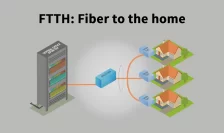
Discover FTTH technology—how it works, its advantages, and how LINK-PP's solutions can enhance your broadband experience.
QAM modulation boosts data transmission by varying amplitude and phase, enabling faster, more efficient communication in Wi-Fi, cable TV, and broadband.
Polarization mode dispersion in fiber optics causes signal distortion and limits data speed. Understand PMD's impact and how to manage it in modern networks.
Discover what HDI PCB (High-Density Interconnect) is, its advantages, manufacturing techniques, and key applications in modern electronics and 5G devices.
Discover the role of isolation voltage in LAN transformers, why IEEE 802.3 sets 1500 Vrms, and how LINK-PP products ensure safe, reliable Ethernet connections.
DP-QPSK (Dual-Polarization QPSK) doubles data rates by using two polarizations, boosting bandwidth efficiency for fiber and satellite communications.
QSFP56 optical transceivers enable 200G Ethernet, high-density connections, and efficient upgrades for modern data center networks.
Explaining what true SFF modules are, their critical advantages in fixed-configuration systems, and why they remain a cornerstone of modern network design.
Explore ADAS (Advanced Driver Assistance System) functions, safety benefits, and how LINK-PP Ethernet magnetics, RJ45 connectors, and optical modules support reliable vehicle networks.
Learn what an SFP link is, why it fails, and how to fix compatibility, cabling, and link-flap issues with practical checks and clear steps.
What are SFP ports on a switch? Learn how SFP ports support fiber and Ethernet connections, how they compare with RJ45 and SFP+, and which module you need.
Optical transceivers in UAVs enable high-speed, secure, and low-latency drone communication for real-time video, telemetry, and mission-critical data.
Explore the technology behind 400 G QSFP‑DD transceivers, including form factor, modulation, optical lanes, and thermal design.
Understand hot‑pluggable optical modules insertion cycle limits, and learn care tips—including ESD-safe handling, dust prevention, and heat management.
Discover how Small and Medium-sized Businesses SMBs use SFP modules to build scalable, cost-efficient, and future-ready business networks.
An SGMII SFP transceiver enables fast Ethernet connections over copper or fiber, supporting flexible speeds and device compatibility in modern networks.
Explain the key differences between FC SFP and Ethernet SFP modules, including compatibility, SAN vs LAN use cases, speeds, and deployment tips.
Discover Fiber Channel Transceiver use cases, SAN deployment tips, FC SFP compatibility, speeds, troubleshooting, and enterprise storage applications.
Learn what SFP technology is, how SFP modules work, common compatibility issues, and how to choose the right transceiver for your network.
Power Over Ethernet (PoE) combines power and data delivery via a single cable, simplifying installations for devices like IP cameras, VoIP phones, and IoT systems.
PCBA stands for Printed Circuit Board Assembly. It's essentially a bare PCB that has had all the necessary electronic components soldered onto it.
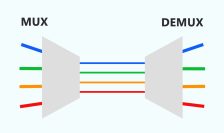
Wavelength Division Multiplexing (WDM) uses optical transceiver modules to send multiple data streams through a single fiber, boosting bandwidth and efficiency.
The TOSA is a critical component in optical transceivers, converting electrical signals into optical signals for high-speed fiber optic communication.
The Receiver Optical Sub-Assembly (ROSA) is a critical optoelectronic component in Optical Tranceivers, responsible for converting incoming optical signals into
DDM/DOM in optical transceivers provides real-time monitoring of key parameters like temperature and power, ensuring network reliability and early issue detection.
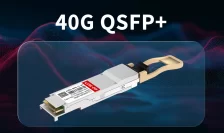
40G QSFP+ transceiver LQ-M8540-SR4I delivers reliable, high-speed data and durability for industrial networks, even in extreme conditions.
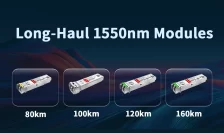
Discover how far 1550nm optical transceivers can transmit over single-mode fiber—up to 160km. See LINK-PP models engineered for long-haul use.
Learn the main applications of 1550nm optical modules in backbone, metro, and enterprise networks. Discover LINK-PP transceivers designed for long-distance fiber links.
LS-MM8532-S1C SFP28 Transceivers offer 25G/32G speeds, broad compatibility, low power use, and cost savings—ideal for future-proofing your data center.
10GBASE-LRM Industrial Transceiver Supports 10.3Gbps, 220m MMF reach, industrial temperature (-40~85°C), and full compatibility with Cisco, Arista, Dell, H3C.
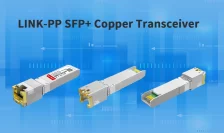
Discover the LINK-PP 10GBase-T Copper SFP+ Transceiver. Supporting 10Gbps over Cat6a/7 cables up to 80m. Compatible with Cisco, Dell, H3C, Juniper, and Arista.
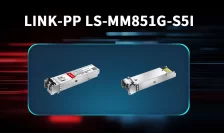
Discover how the LINK-PP LS-MM851G-S5I 1000BASE-SX transceiver offers a 100% compatible, high-performance, and cost-effective solution to replace GLC-SX-MMD.
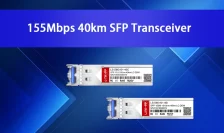
Review of the LINK-PP LS-SM3101-40C SFP 155Mbps 40km SMF Optical Transceiver Module, covering features, compatibility, diagnostics, and value for networks.

Explore the LINK-PP LS-SM3110-10C 10G 10km SFP+ module. Discover specs, applications & why it's a top choice for reliable, long-distance fiber connectivity.
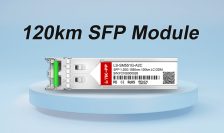
Discover LINK-PP’s LS-SM551G-A2C – a 1G 120km SFP module, high compatibility, and best-in-class value for large-scale fiber deployments.
Add Your Heading Text Here