Welcome to the LINK-PP Community

More Posts

Learn what Parallel Optics is, how it enables high-speed data transmission and how LINK-PP QSFP28 SR4 and 200/400/800G transceiver modules support this technology.
InfiniBand is a high-speed network technology enabling fast, low-latency data transfer in data centers and HPC environments using RDMA.
InfiniBand vs Ethernet: Compare latency, throughput, cost, and scalability to choose the best network solution for your data center needs.
10GBASE-LRM Industrial Transceiver Supports 10.3Gbps, 220m MMF reach, industrial temperature (-40~85°C), and full compatibility with Cisco, Arista, Dell, H3C.
A backbone network connects subnetworks with high-speed fiber optics, ensuring fast, reliable data transmission across cities, regions, and countries.
Compare sfp28-25g-esr and sfp28-25g-sr modules for 25G networks. See key differences in distance, fiber type, and best use cases for data centers.
FAQ Summary of optical modules: answers on types, compatibility, design, troubleshooting, and glossary for 2025 network upgrades and maintenance.
Explore the future of 850nm optical modules in data centers, covering SR8/SR16 advancements, parallel optics, and the impact of single-mode fiber adoption.
10GBASE-SR, 40GBASE-SR4, 100GBASE-SR4, and 400GBASE-SR8 850nm optical modules are the most reliable and cost-effective choice for short-reach multimode fiber connections.
Coherent transceivers use phase, amplitude, and polarization to deliver high-speed, long-distance data transmission with improved signal quality.
Learn what an SFP link is, why it fails, and how to fix compatibility, cabling, and link-flap issues with practical checks and clear steps.
What are SFP ports on a switch? Learn how SFP ports support fiber and Ethernet connections, how they compare with RJ45 and SFP+, and which module you need.
Optical transceivers in UAVs enable high-speed, secure, and low-latency drone communication for real-time video, telemetry, and mission-critical data.
Explore the technology behind 400 G QSFP‑DD transceivers, including form factor, modulation, optical lanes, and thermal design.
Understand hot‑pluggable optical modules insertion cycle limits, and learn care tips—including ESD-safe handling, dust prevention, and heat management.
Discover how Small and Medium-sized Businesses SMBs use SFP modules to build scalable, cost-efficient, and future-ready business networks.
An SGMII SFP transceiver enables fast Ethernet connections over copper or fiber, supporting flexible speeds and device compatibility in modern networks.
Explain the key differences between FC SFP and Ethernet SFP modules, including compatibility, SAN vs LAN use cases, speeds, and deployment tips.
Discover Fiber Channel Transceiver use cases, SAN deployment tips, FC SFP compatibility, speeds, troubleshooting, and enterprise storage applications.
Learn what SFP technology is, how SFP modules work, common compatibility issues, and how to choose the right transceiver for your network.
Discover how DDMI—the Digital Diagnostic Monitoring Interface—gives real-time insights into optical transceivers. Learn its key metrics, benefits, and how LINK-PP modules support it.
Remote Direct Memory Access boosts data transfer speed, lowers latency, and reduces CPU usage for high-performance computing and cloud applications.
A Storage Area Network connects servers to shared storage, offering fast, reliable, and centralized data access for businesses with large data needs.
OTN is a digital transport standard defined by ITU-T for high-capacity optical transmission. Learn how LINK-PP optical transceivers enable OTN-based connectivity.
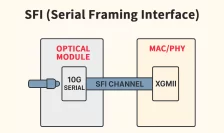
Learn how the Serial Framing Interface (SFI) enables high-speed data transmission in 10G SFP+ and 40G QSFP+ optical modules. Explore SFI channels, XGMII conversion, and module interoperability for reliable networking.
Discover how EEPROM ensures reliable configuration, superior compatibility, and lifetime flexibility in networking hardware: from RJ45 to optical modules.
Discover what IEEE means for network hardware, key standards like IEEE 802.3, and how LINK-PP delivers certified, reliable Ethernet solutions for B2B procurement.
High-performance computing uses powerful systems to solve complex problems and process large data sets quickly for science, business, and technology.
An application-specific integrated circuit, or ASIC, is a microchip made for a special job. Let's dive into the world of ASIC! Discover what exactly is an ASIC.
Learn what crosstalk is in Ethernet, how it affects signal quality, and how LINK-PP designs help reduce interference for reliable data transmission.
Learn what 40GBASE-ER4 is, how far it reaches over duplex single-mode fiber, what it supports, and how to choose the right QSFP+ optic.
Understand SFP 850nm vs 1310nm differences in fiber type, distance, cost, and use cases. Learn which SFP module is right for your network.
Learn what a 2.5 Gbps SFP module is, how it works, and compatibility with SFP+ ports. Explore performance insights, standards, and buying tips.
Learn 2.5G Copper SFP (2.5GBASE-T), compatibility, Cat5e/Cat6 support, 100m reach, and why it bridges 1G and 10G Ethernet upgrades.
Complete guide to GLC-SX-MMD 1000BASE-SX SFP module: specs, MMF vs SMF, DOM features, compatibility, and best alternatives for cost-effective deployment.
Learn how compatible transceivers work and how to ensure switch compatibility. Avoid SFP errors, vendor locks, and choose the right module confidently.
Learn what an MMF SFP Module is, how it differs from SMF, how to identify it, and how to avoid compatibility mistakes in real deployments.
Learn what Small Form-factor Pluggable Plus SFP+ is, how it works, compatibility rules, common use cases, and how to choose the right module.
Learn how a 1000BASE-T SFP transceiver module works with Category 5 copper wire, including compatibility limits, heat issues, and real-world deployment tips.
Learn the SFP28 standard, including its 25G capabilities, SFP28 vs. SFP+ differences, fiber and copper options, and how to choose the right 25G solution.

Add Your Heading Text Here