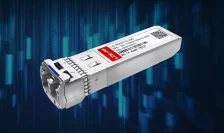
What are SFP ports on a switch? Learn how SFP ports support fiber and Ethernet connections, how they compare with RJ45 and SFP+, and which module you need.
Discover the LQ‑SW40‑SR4C 40GBASE‑SR module: high-speed, low-power, QSFP+ optics for multimode fibre networks. Perfect for data centres and network upgrades.
Receiver sensitivity shows the lowest signal a device can detect. Learn how it impacts connection quality and what values mean for your device’s performance.
Learn the differences between Big Data and Traditional Data, including scale, speed, complexity, and infrastructure needs. Discover how optical modules enable modern Big Data workloads.
Discover what Big Data is, its 5V characteristics, real-world applications, technologies, and future trends. Learn how optical transceivers support Big Data networks.
Learn what OMA (Optical Modulation Amplitude) means in optical communications, how to calculate it from P₁/P₀ and extinction ratio, and why it’s critical in transceiver specs like LINK-PP SFP modules.
Discover how LINK-PP’s high-performance SFP/SFP+ transceivers enable low-latency, scalable connectivity for modern databases and data centers. Explore technical specs, use cases, and integration tips.
EPON delivers fast, reliable internet using fiber-optic cables with a simple, cost-effective design, making it ideal for homes and businesses seeking high-speed access.
Explore the world of resistors with our in-depth guide. Learn about different types, their applications, and specifications to make informed decisions for your electronic projects.
Software-Defined Networking offers centralized control, flexibility, and automation for efficient network management and rapid adaptation to changing needs.
Explore how Data Processing Units (DPUs) optimize data center performance, accelerating networking, storage, and security. Discover LINK-PP optical modules for high-speed interconnects.
Explore the fundamental differences between GPUs and CPUs, their architectural distinctions, and performance benchmarks to understand which processor suits your computing needs.
Long Term Evolution (LTE) is a 4G wireless standard offering high-speed, low-latency data for mobile devices, enabling fast, reliable internet connections.
OFDMA vs SC-FDMA: Compare their roles in LTE/5G, impact on download speed, battery life, and why networks use OFDMA for downlink and SC-FDMA for uplink.
Learn how LDP (Label Distribution Protocol) establishes Label Switched Paths in MPLS networks. Understand LDP functions, working principles, and relation to LINK-PP products.
Central Management Server streamlines server management, enabling secure, centralized control, updates, and monitoring for multiple systems in one place.
Dispersion compensation in optical systems corrects chromatic dispersion, ensuring clear, accurate signals in fiber optic communication and imaging applications.
Remote network monitoring enables real-time network management, security, and troubleshooting from any location, supporting both remote teams and multiple site.
Learn what Multipoint-to-Point (MP2P) architecture is, how it works, and how LINK-PP optical transceivers enhance data efficiency in modern fiber networks.
Learn how multipoint-to-multipoint (MP2MP) networks work, their advantages, and applications in optical communications. Discover LINK-PP optical modules supporting MP2MP systems.
In-band Network Telemetry embeds real-time monitoring data in each packet, enabling instant network insights, troubleshooting, and performance analysis.
Explore the fundamentals of Point-to-Point (P2P) network architecture, its working principles, and how LINK-PP RJ45 connectors and optical transceivers enable reliable high-speed communication.
Discover the LQ‑SW40‑SR4C 40GBASE‑SR module: high-speed, low-power, QSFP+ optics for multimode fibre networks. Perfect for data centres and network upgrades.
Learn what hyperconverged infrastructure HCI is, how it compares with virtualization and dHCI, and when Nutanix, Sangfor, or SFP-based designs fit best.
Understand SFP+ 40km (10GBASE-ER) modules, including specs, SMF compatibility, and how to choose the right extended-reach optical transceiver for your network.