



In today’s industrial automation landscape, the distributed control system (DCS) is a foundational architecture that ensures reliable, scalable, and real-time process control. This article explains DCS architecture, applications, benefits, and modern trends, highlighting how LINK‑PP connectivity solutions support DCS implementations.
⚙️ What is a Distributed Control System (DCS)?
Definition and Core Concept
A distributed control system (DCS) is a computerized automation system designed to control industrial processes with multiple control loops through decentralized controllers. Unlike a single central controller, a DCS distributes control nodes across the plant, improving reliability and real-time responsiveness.
Why “Distributed”?
Control functions are spread across multiple nodes near field devices (sensors and actuators). This decentralisation reduces single-point failures and ensures faster local responses, making DCS ideal for large-scale, continuous, or batch process industries.
⚙️Key Components and Architecture of a DCS
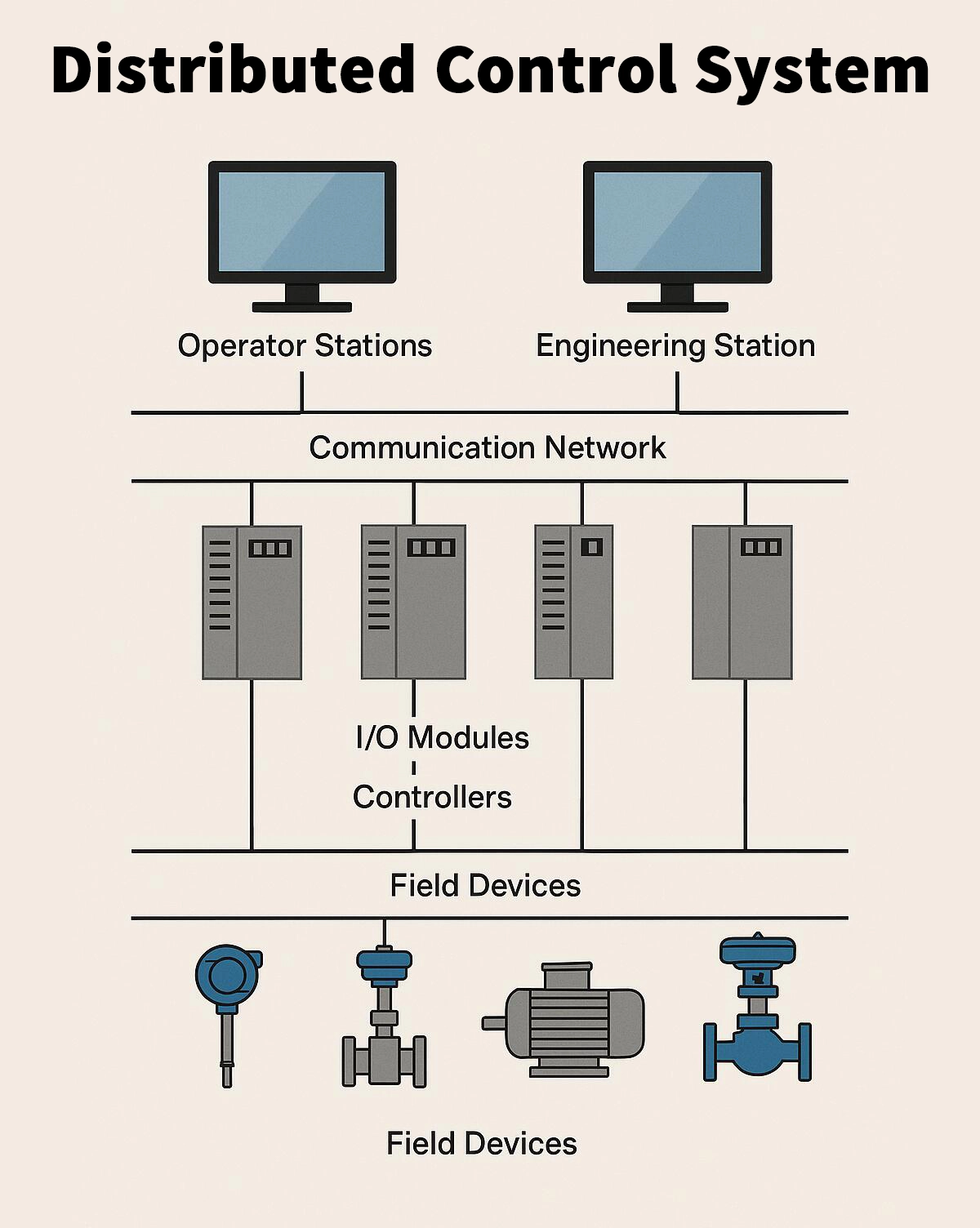
Typical Layers
Field devices (Level 0): Sensors, transmitters, and actuators that measure and act on process variables.
I/O modules and local controllers (Level 1): Execute control logic and interface with field devices.
Supervisory computers/operator stations (Level 2): Provide Human-Machine Interface (HMI) for monitoring, alarms, and manual intervention.
Engineering station & historian: For configuration, programming, data logging, and analytics.
Communication network: High-speed, redundant plant networks (Ethernet, Profibus, Modbus) linking all layers.
Functional Modules
Control nodes/controllers: PID loops, logic execution, alarm handling.
HMI/operator interface: Visualisation and operator controls.
Alarming and event management: Alerting for threshold breaches.
Data logging/historian: Historical process data for analysis.
Engineering environment: Configuration, updates, and optimisation.
Modern Integration
DCS now integrates with IIoT, cloud analytics, and open protocols for data-driven process optimisation and predictive maintenance.
⚙️Use Cases and Industries
Typical Industries
Chemical, petrochemical, and refinery plants
Power generation and utilities
Water and wastewater treatment
Pharmaceutical, food & beverage, pulp & paper
Mining and metals processing
Why DCS Fits
DCS is ideal where:
Thousands of control loops operate simultaneously
High availability is essential
Continuous or batch processes require precise real-time control
⚙️Benefits of Implementing a DCS
Reliability & Fault Tolerance
Distributed nodes reduce the risk of a full system shutdown.
Scalability & Flexibility
Easily add new control loops or expand the system without redesigning a central controller.
Process Efficiency & Data-Driven Optimisation
Integrated data logging and analytics improve yields, energy efficiency, and reduce downtime.
Operator Experience
Modern HMI displays, alarms, and trend analytics provide better control and visibility.
Safety & Cybersecurity
Central oversight of distributed units supports safety instrumentation and cybersecurity strategies.
⚙️DCS vs PLC vs SCADA
DCS vs PLC: PLCs control individual machines; DCS controls entire plants with thousands of interlinked loops.
DCS vs SCADA: SCADA focuses on remote monitoring; DCS provides real-time control with integrated process loops.
Selecting the right system depends on process size, number of loops, uptime requirements, and scalability.
⚙️Key Considerations for Deployment
♦ Network & Communication: High-speed, low-latency networks with redundancy are essential.
♦ Connectivity Hardware: Industrial-grade RJ45 connectors and USB/RJ45 combo connectors from LINK‑PP ensure reliable field-to-controller communication.
♦ Cybersecurity: Secure architecture, segmentation, and intrusion detection are critical in connected DCS systems.
♦ Operator Training: Staff must effectively use HMI, alarms, and trends.
♦ Vendor Choice & Open Architecture: Multi-vendor interoperability and open standards support future-proof systems.
⚙️Future Trends in DCS
IIoT & Edge Computing: Controllers integrate edge analytics and cloud connectivity.
AI & Machine Learning: Real-time data enables predictive maintenance and process optimisation.
Cybersecurity & Open Systems: Increased connectivity requires secure, open architectures.
Digital Twins & Sustainability: DCS interfaces with simulation models to optimise energy and processes.
⚙️How LINK‑PP Supports DCS Deployments
LINK‑PP’s RJ45 connectors, USB/RJ45 combo connectors, and other industrial connectivity products offer:
Durable, industrial-grade design for harsh environments
Compatibility with high-speed Ethernet networks used in DCS systems
Reliable, low-latency connections for field-to-controller communication
Streamlined global supply for automation integrators
⚙️Summary
DCS distributes control across multiple nodes, improving reliability and real-time performance.
Suited for large-scale continuous and batch process industries.
Benefits include scalability, efficiency, operator visibility, safety, and optimisation.
DCS differs from PLCs (machine-level control) and SCADA (remote monitoring).
Deployment requires attention to network architecture, connectivity, cybersecurity, training, and vendor strategy.
Future DCS trends include IIoT integration, AI-driven optimisation, open architectures, digital twins, and sustainability.
LINK‑PP connectivity solutions provide the reliable infrastructure DCS systems need for modern industrial automation.


