




📌 What is TDECQ (Transmitter and Dispersion Eye Closure Quaternary)
TDECQ stands for Transmitter and Dispersion Eye Closure Quaternary. It is a standardized measurement — defined under the IEEE 802.3 standard family — used to quantify the optical quality of a PAM4 transmitter when driving an optical link.
In practice, TDECQ expresses how much additional optical power (or margin) is required for a real transmitter — after considering noise, inter-symbol interference (ISI), dispersion, and other impairments — to achieve the same “eye opening” that an ideal transmitter would provide. A lower TDECQ value indicates better signal quality and typically correlates with lower bit error rates.
Because modern high-speed links increasingly use PAM4 modulation (e.g., 50G, 100G, 200G, 400G), TDECQ has become the de facto key metric to ensure transmitter compliance and link reliability.
📌 Why Traditional Metrics Were Not Enough
The Shift from NRZ to PAM4
In earlier generations based on NRZ (two-level signaling), optical transmitters were evaluated using extinction ratio, outer OMA, and eye-mask margin. For higher link budgets, TDP (Transmitter and Dispersion Penalty) was sometimes used. However, TDP testing requires complex setups and is time-consuming.
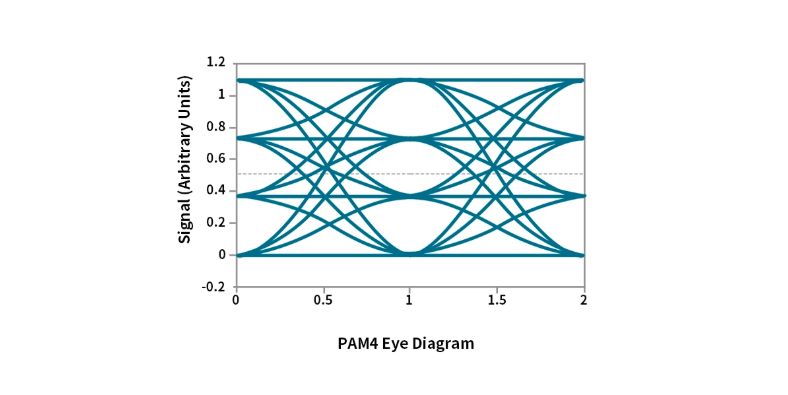
With PAM4, the signal has four levels, compressing the eye diagram and making traditional eye-mask metrics insufficient. Noise, ISI, dispersion, and unequal sub-eye levels demand a more robust, repeatable metric — TDECQ.
📌 How TDECQ is Defined and Measured
Basic Concept — Power Penalty Relative to Ideal Transmitter
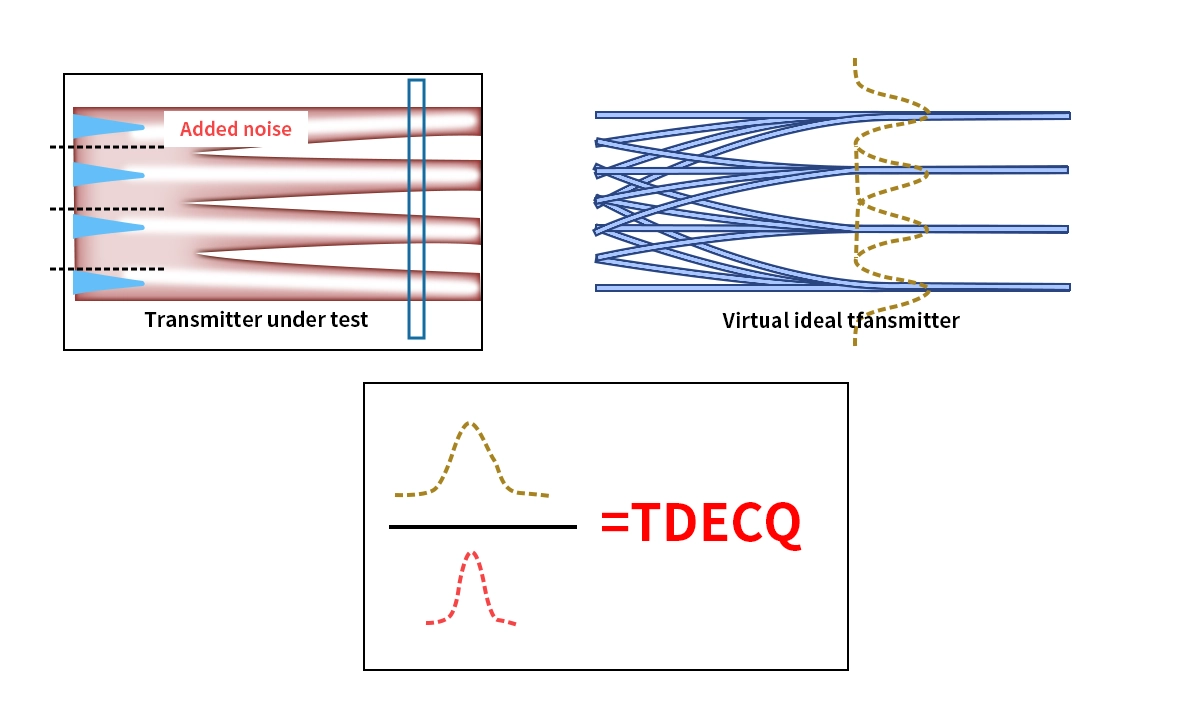
TDECQ is defined as the extra optical power (in dB) that a measured transmitter requires to achieve the same vertical eye opening (after equalization) as an ideal transmitter under the same reference link conditions.
During measurement, the transmitter output is captured by a reference optical-to-electrical converter and a reference equalizer. Algorithms calculate TDECQ based on waveform amplitude, noise, ISI, and dispersion.
Typical TDECQ Limits in Industry Standards
For standards like 50GBASE-FR / 50GBASE-LR / 100GBASE-DR, TDECQ maximum limits are typically around 3.2–3.4 dB. Meeting these limits ensures sufficient vertical eye margin for reliable receiver performance.
📌 What TDECQ Reflects — Its Scope and Limitations
▷ What TDECQ Captures
Vertical eye closure: quantifies amplitude distortion, sub-eye imbalance, and optical dispersion.
Combined transmitter + link impairments: includes noise, ISI, and dispersion effects.
Margin for receiver equalizers: ensures the eye opening remains acceptable after equalization.
▷ Limitations
TDECQ does not fully describe temporal jitter or non-linear distortions.
It assumes a reference receiver; actual device receivers may differ.
For very high-speed links (200G, 400G, 800G), TDECQ must be interpreted alongside OMA, launch power, extinction ratio, and link budget.
📌 Implications of TDECQ for Optical Module Design and Selection
For manufacturers, TDECQ compliance is a key quality metric. Modules passing the TDECQ spec provide:
Well-designed transmitter with minimal penalty.
Robust PAM4 eye after dispersion and other impairments.
Reliable link budget and receiver margin for high-speed deployments.
For buyers, checking TDECQ compliance ensures future-proof performance and lowers the risk of link failures.
📌 Summary & Recommendations
TDECQ is the standard metric for assessing PAM4 transmitter and link quality.
Lower TDECQ indicates better optical signal quality and vertical eye opening.
Typical TDECQ maximum values for 50G/100G PAM4 modules are 3.2–3.4 dB.
Verify TDECQ along with OMA, launch power, extinction ratio, receiver sensitivity, and link budget when selecting optical transceivers.
Optimizing transmitter design and minimizing penalties ensures high-quality PAM4 modules suitable for modern data centers and telecom applications.
Explore LINK-PP PAM4 Optical Transceivers for TDECQ-compliant, high-performance modules.


