




🌐 Bandwidth Demands in the 6G Era
6G networks are expected to deliver data rates up to 1 Tbps with sub-millisecond latency, driving unprecedented demands on optical communication infrastructure.
Compared with 5G, 6G introduces:
10× increase in user data throughput
Higher operating frequencies (up to THz bands)
Ultra-dense edge computing nodes and massive MIMO
This results in exponential growth in fronthaul, midhaul, and backhaul traffic, requiring optical transceivers to support ultra-high-bandwidth, low-latency, and energy-efficient data transmission.
🌐 Key Bandwidth Challenges for Optical Transceivers
● Increasing Data Rate per Lane
Current 400G/800G transceivers (based on PAM4 modulation) are reaching their bandwidth and power density limits.
6G networks will likely require 1.6T and 3.2T optical modules, with per-lane speeds reaching 200–400Gbps, pushing existing electrical and optical components to their physical boundaries.
● Signal Integrity and Channel Loss
At terabit speeds, signal attenuation, dispersion, and crosstalk become critical issues. Maintaining high signal-to-noise ratios across PCB traces and fiber channels demands improved:
Equalization and pre-emphasis techniques
Low-loss PCB materials
Advanced optical packaging (Co-Packaged Optics, CPO)
● Power Efficiency
As data rates scale, power per bit increases sharply.
6G networks must balance high bandwidth and sustainability, which challenges traditional DSP-based designs and drives adoption of energy-efficient modulation and integrated photonics.
● Thermal Management
High-speed optical engines generate significant heat.
Without optimized thermal pathways, temperature-induced wavelength drift can degrade signal quality. Efficient heat dissipation and co-packaged cooling become essential.
🌐 Technological Solutions for 6G Optical Bandwidth
◆ Co-Packaged Optics (CPO)
CPO integrates optical engines directly next to switch ASICs, dramatically reducing electrical I/O loss and power consumption.
It’s seen as a core enabler of 1.6T+ optical interconnects for 6G data centers and baseband units (BBUs).
◆ Silicon Photonics Integration
Silicon photonics (SiPh) combines optical and electronic functions on a single chip, supporting:
Higher port density
Better thermal stability
Cost-efficient mass production
It’s the foundation of next-gen 800G / 1.6T transceiver architectures.
◆ Advanced Modulation and Coding
Moving beyond PAM4, 6G may adopt:
Coherent modulation (QPSK, 16-QAM) for long-distance fronthaul
Probabilistic constellation shaping (PCS) for improved spectral efficiency
DSP-assisted adaptive equalization to optimize power usage dynamically
◆ Wavelength and Space Division Multiplexing
To expand fiber capacity, WDM (Wavelength Division Multiplexing) and SDM (Space Division Multiplexing) will coexist, enabling multi-terabit throughput across fewer physical fibers.
◆ Intelligent Optical Network Management
With 6G’s AI-native framework, AI-driven transceiver management will monitor optical power, BER, and temperature in real time — predicting failures and adjusting parameters autonomously to maintain reliability.
🌐 LINK-PP Optical Transceiver Solutions for 6G Readiness
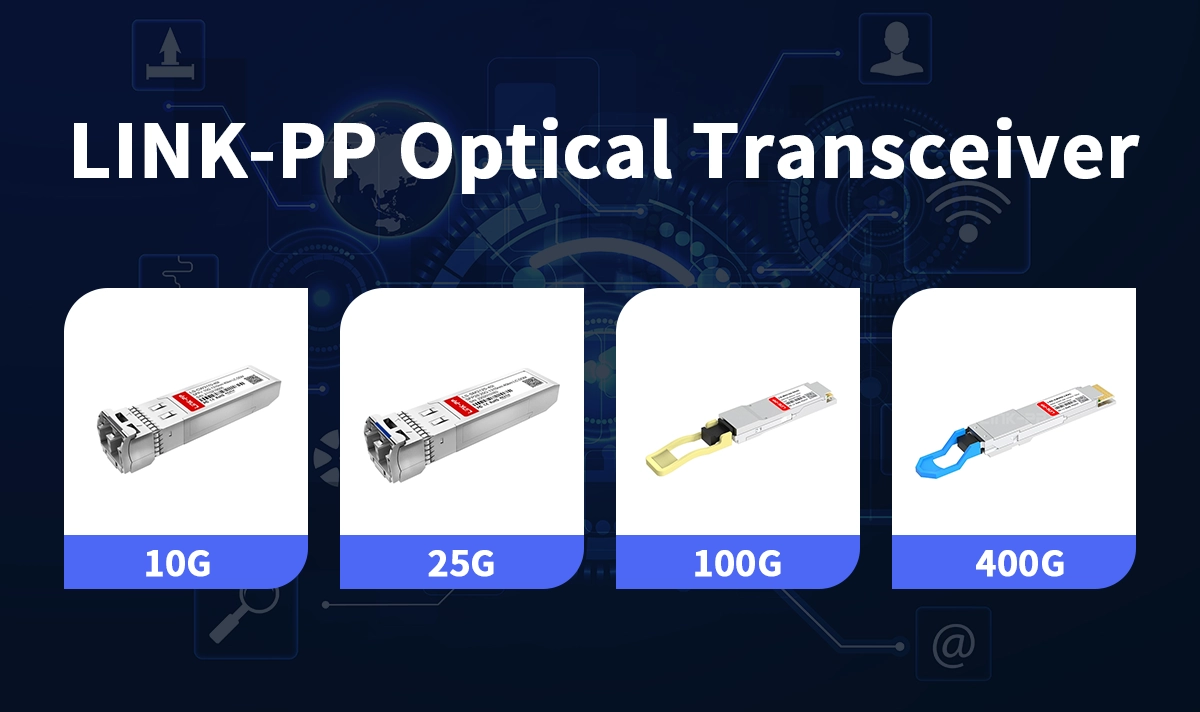
LINK-PP is addressing 6G bandwidth challenges through its high-performance optical transceivers and magnetic Ethernet solutions, designed for both telecom and data center environments.
Highlighted 6G-Compatible Products:
LS-CW3110-40I — CPRI/eCPRI-compatible SFP+ module for 10G fronthaul networks
LS-SM3125-40I— 25G optical transceiver supporting next-gen radio access
LQ-M85100-SR4C — 100G short-reach transceiver optimized for low-latency edge computing
Upcoming 400G/800G modules — Built on a silicon photonics platform with PAM4 modulation and low power design
These products deliver:
High data throughput with minimal signal loss
Industrial-grade reliability (–40°C to +85°C)
Compatibility with 6G-ready eCPRI and CPRI protocols
🌐 Future Outlook
6G’s vision of intelligent, immersive, and ubiquitous connectivity will redefine the optical layer as a key enabler of distributed computing and AI-driven communication.
To meet terabit-scale demands, optical transceivers must evolve toward integrated, adaptive, and sustainable architectures.
With continuous innovation in magnetics, transceivers, and network components, LINK-PP is positioned to play a vital role in building the optical backbone of 6G networks.
Also Read:
eCPRI (Enhanced Common Public Radio Interface) & 5G Fronthaul
What You Should Know About QPSK Modulation: Basics & Advantages
Technical Hurdles for 1.6T Optical Transceivers & Connector Revolution
Author: LINK-PP Technical Editorial Team


