



Navigating the world of legacy fiber optic infrastructure can be a complex task. Among the various components, two soldered transceiver form factors often cause confusion: the SFF (Small Form-Factor) and the 1×9 transceiver.
While modern hot-pluggable optics like SFP and QSFP dominate today’s data centers, understanding these older, board-mounted technologies is crucial for maintaining and upgrading existing network equipment. This guide will clearly distinguish between SFF and 1×9 modules, highlighting their key differences to help you make informed decisions about your legacy network needs.
➤ The Classic Workhorse: The 1×9 Transceiver
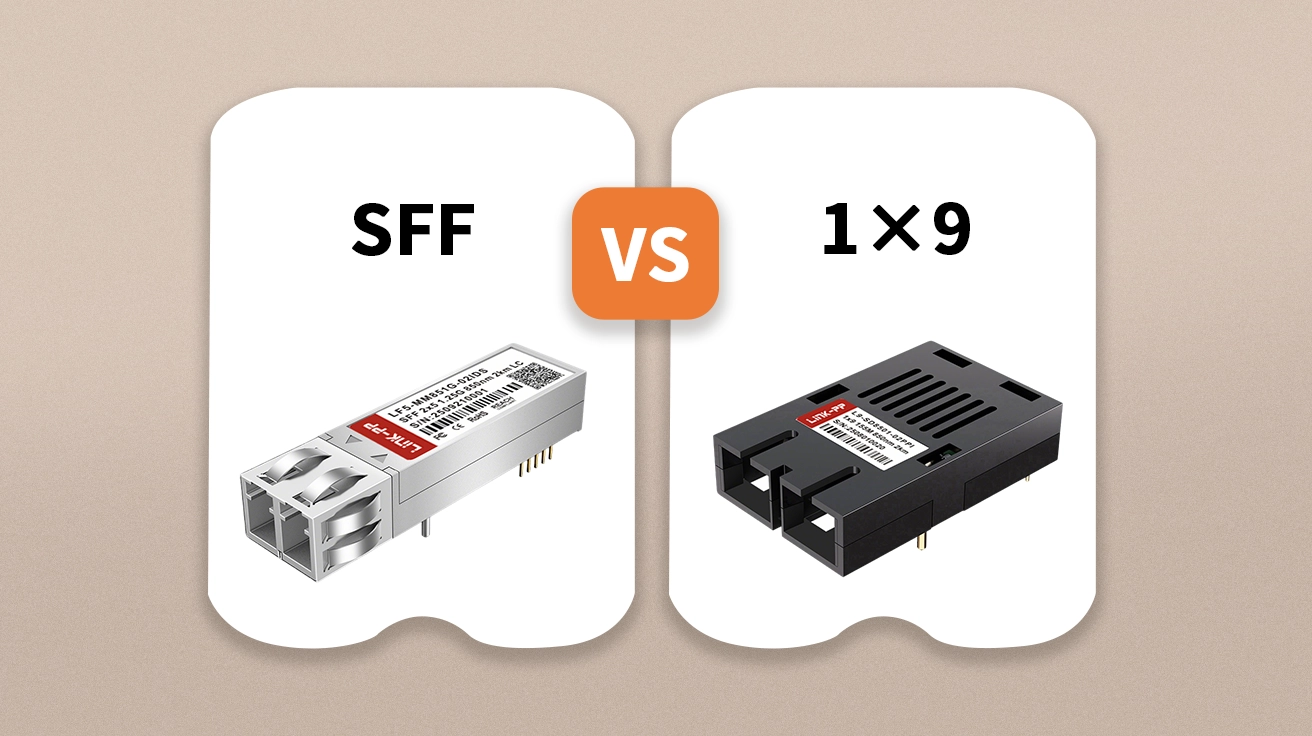
The 1×9 transceiver is one of the earliest standardized optical module form factors. Its name comes from its physical interface: a single row of 9 pins for soldering directly onto a system’s motherboard (PCB).
Key Characteristics of 1×9:
Board-Mounted Design: It is a solder-down module, permanently attached to the host board. It is not pluggable or hot-swappable.
Larger Footprint: It is relatively bulky by modern standards, resulting in lower port density on a line card.
Simple Functionality: It typically supports essential functions with limited diagnostics, often only a Loss of Signal (LOS) output.
Primary Applications: Predominantly found in very old networking gear like hubs, switches, and routers, supporting Fast Ethernet (100BASE-FX) and 1G/2G Fiber Channel.
➤ The Density Innovator: The SFF Transceiver
The SFF (Small Form-Factor) transceiver was developed as a successor to the 1×9 to address its size and density limitations. It is crucial to note that the SFF is also a solder-down module. It was designed to be smaller and pave the way for more advanced features, later leading to the creation of the pluggable SFP (Small Form-factor Pluggable) standard.
Key Characteristics of SFF:
Soldered, but Smaller: Like the 1×9, the SFF is soldered to the PCB, but its physical footprint is significantly smaller (e.g., with 2×5, 2×7, or 2×10 pin configurations), enabling higher port density.
Advanced Capabilities: Many SFF modules integrated support for Digital Diagnostic Monitoring (DDM or DOM) as per the SFF-8472 MSA, providing vital real-time data on temperature, optical power, and laser bias current.
Primary Applications: Became the standard for board-mounted Gigabit Ethernet (1000BASE-SX/LX/ZX) applications in switches, routers, and network interface cards (NICs) before the SFP took over.
➤ SFF vs 1×9: A Detailed Comparison
The following table provides a clear, side-by-side comparison of these two legacy form factors.
Feature | SFF Transceiver | 1×9 Transceiver |
|---|---|---|
Form Factor | Small Form-Factor (e.g., 2×5, 2×7 pins) | Single Row of 9 pins |
Connection Type | Soldered to PCB | Soldered to PCB |
Hot-Pluggable | ❌ No | ❌ No |
Port Density | ✅ High (Due to smaller size) | ❌ Low |
Typical Data Rates | Fast Ethernet, Gigabit Ethernet | Fast Ethernet, Fiber Channel |
Digital Diagnostics (DDM/DOM) | ✅ Often Supported | ❌ Rarely Supported |
Modern Relevance | Found in later legacy gear | Found in older legacy gear |
➤ Choosing the Right Module for Your Application
Your choice is almost entirely determined by the hardware you are working with.
You need a 1×9 Transceiver if: You are repairing or maintaining very old legacy equipment that was originally designed with 1×9 pins soldered onto the motherboard.
You need an SFF Transceiver if: Your device’s motherboard has footprints for the specific SFF pin configuration (e.g., 2×5 or 2×7). For instance, a LINK-PP LF5-MM851G-S5IDS would be a perfect, reliable choice for a Gigabit multi-mode application requiring a 2×5 pin solder-down module.
➤ Maintaining Legacy Systems with Confidence
Understanding the distinction between these soldered form factors is key to effective network maintenance. Sourcing high-quality, compatible modules is essential for reliability.
LINK-PP provides MSA-compliant optical components, including legacy form factors like SFF modules. With a commitment to quality and performance, LINK-PP ensures your legacy infrastructure remains operational and efficient.
👉 Need a reliable source for legacy SFF or 1×9 transceivers? Contact the LINK-PP experts today for a compatibility check and technical support. Let us help you keep your network running smoothly.


