




Amazon Web Services (AWS) is the world’s largest and most widely adopted cloud platform, delivering more than 200 on-demand services across computing, storage, networking, databases, machine learning, and security. As businesses accelerate cloud transformation, understanding AWS cloud architecture and its underlying high-speed network infrastructure is essential for IT teams, developers, and data-driven organizations.
This article provides a structured and authoritative overview of AWS, while explaining how modern data centers—including AWS regions—depend on high-performance optical transceivers, such as SFP/SFP+/SFP28 modules, to support scalable cloud workloads.
🖥️ What Is AWS (Amazon Web Services)?
AWS is Amazon’s secure cloud computing platform that provides pay-as-you-go access to servers, storage, databases, networking, and application services. Instead of buying and maintaining physical hardware, companies deploy applications on AWS to achieve:
On-demand scalability
Global low-latency performance
High availability and redundancy
Cost optimization
Flexible hybrid and multi-cloud architectures
AWS powers millions of organizations worldwide, from startups to enterprises and government sectors.
🖥️ How AWS Cloud Architecture Works
AWS architecture is built on Regions, Availability Zones (AZs), and a global high-speed backbone network.
● AWS Regions
A Region is a physical geographic area (e.g., us-east-1, eu-west-1) that contains multiple isolated data centers.
● Availability Zones
Each Region includes multiple AZs interconnected with low-latency links.
These AZs provide:
Fault isolation
High redundancy
Resilient distributed applications
● AWS Global Network Backbone
AWS uses a dedicated global fiber infrastructure that interconnects regions with terabit-level throughput.
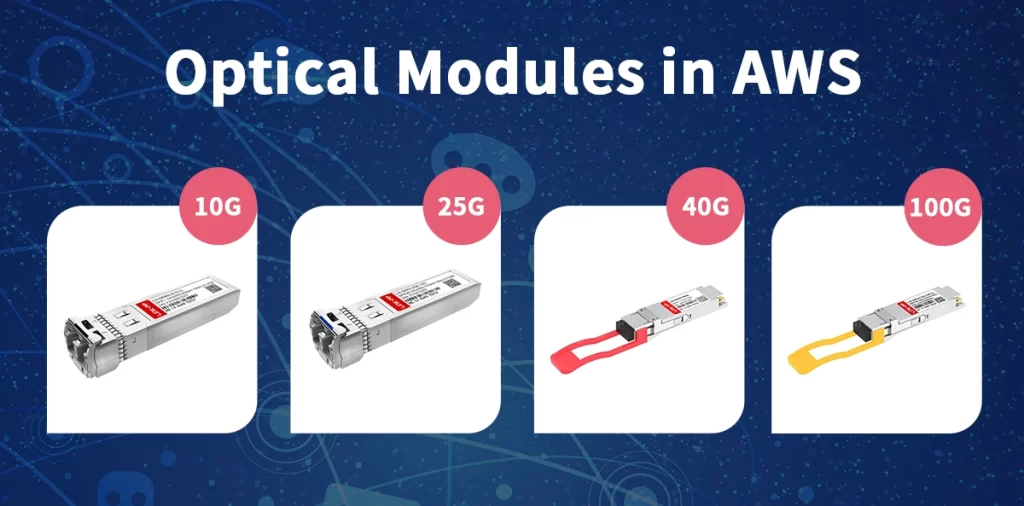
Inside each AWS data center, high-speed links rely heavily on:
These optical components enable ToR/Leaf/Spine network architectures required for scalable cloud workloads.
🖥️ Core AWS Services Explained
AWS offers services across multiple categories:
1. Compute Services
EC2 – Virtual servers
Lambda – Serverless computing
ECS/EKS – Container platforms
2. Storage Services
Amazon S3 – Object storage
EBS – Block storage
EFS – File systems
3. Database Services
RDS – Managed relational databases
DynamoDB – NoSQL
Redshift – Data warehousing
4. Networking Services
VPC – Virtual private cloud networks
Route 53 – DNS
CloudFront – CDN
Direct Connect – Dedicated fiber connectivity to AWS
Direct Connect often integrates 100G optical transceivers for high-bandwidth enterprise links.
🖥️ AWS Networking: Why Optical Transceivers Matter
High-speed networking is the backbone of every AWS Region and AZ. To achieve ultra-low latency and massive throughput, AWS data centers use optical modules in nearly every layer:
Server to Top-of-Rack (ToR) Switches
Common modules:
SFP+ 10GBase-SR/LR
SFP28 25G SR/LR
Leaf to Spine Network Interconnects
Common modules:
40G QSFP+ SR4
100G QSFP28 LR4 / CWDM4
Data Center Interconnect (DCI)
Modules such as 100G DWDM or ZR/ZR+ enable region-level aggregation and long-distance fiber transport.
👉 LINK-PP provides a full selection of high-performance and cost-effective options compatible with cloud-scale infrastructure.
🖥️ Benefits of AWS Cloud Computing
★ Scalability
Scale from one instance to thousands instantly.
★ Reliability
Global AZ design ensures uptime and redundancy.
★ Cost Efficiency
Pay only for the resources used.
★ Security
AWS provides multi-layer defense, encryption, compliance, and identity management.
★ Global Reach
Dozens of regions and hundreds of edge locations deliver near-zero-latency experiences.
🖥️ Where LINK-PP Products Fit Into AWS-Style Architectures
ENTERPRISES building AWS-like private or hybrid cloud architectures can use LINK-PP optical modules to achieve:
High-bandwidth server connectivity
Cloud-optimized virtualized networks
Scalable data center clusters
Stable long-distance optical connections
Cost-efficient high-performance infrastructure
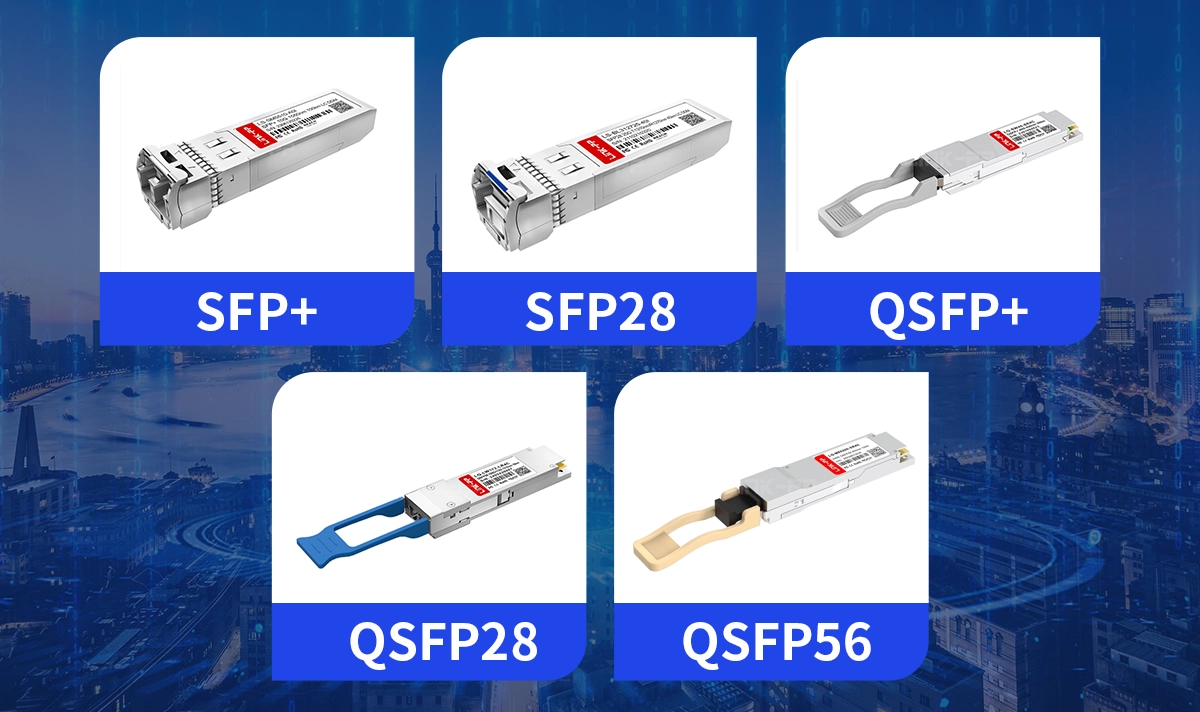
Popular categories include:
10G SFP+ Transceivers
For server NICs and ToR switches.
25G SFP28 Modules
For cloud-ready high-density racks.
40G / 100G QSFP Modules
For leaf/spine networks and aggregation layers.
🖥️ Conclusion
AWS continues to lead the cloud industry with its global infrastructure, extensive service portfolio, and high-performance networking. Behind this cloud ecosystem is a robust data center architecture powered by optical transceivers and high-speed network equipment.
Organizations building cloud-ready networks can enhance performance and reduce operational costs by choosing reliable optical modules such as those offered by LINK-PP.
🖥️ Frequently Asked Questions (FAQ)
Q1: Is AWS a cloud computing platform?
Yes. AWS (Amazon Web Services) is the world’s most widely used cloud computing platform, offering on-demand access to computing, storage, networking, databases, and AI services. It enables organizations to run applications without maintaining physical hardware.
Q2: How does AWS ensure high-speed network performance?
AWS uses a global optical fiber backbone and high-density data center networks built on ToR, Leaf, and Spine architectures. These networks rely on high-speed optical transceivers such as 10G SFP+, 25G SFP28, 40G QSFP+, and 100G QSFP28 modules to achieve low latency and massive throughput.
Q3: Does AWS use optical transceivers?
Absolutely. AWS data centers use millions of optical transceivers for server connections, switching layers, and inter-data-center connectivity. Technologies range from 10G and 25G modules to 40G, 100G, and emerging 200G/400G modules.
Q4: Can enterprises build AWS-like private clouds using third-party optical modules?
Yes. Enterprises can deploy AWS-style cloud networks using industry-standard SFP/SFP+/SFP28/QSFP transceivers. LINK-PP’s optical modules are compatible with mainstream switches and servers used in modern cloud and data center environments.
Q5: What optical transceivers are commonly used in AWS environments?
Typical AWS-scale data centers deploy:
10G SFP+ SR/LR for server access
25G SFP28 SR/LR for high-density racks
40G QSFP+ SR4 for mid-tier aggregation
100G QSFP28 CWDM4/LR4 for spine and DCI connections
These modules deliver the bandwidth required for large-scale cloud workloads.
Q6: How does AWS Direct Connect benefit from optical modules?
AWS Direct Connect uses high-speed fiber connections between enterprise data centers and AWS Regions. Optical transceivers such as 100G LR4, 100G ER4, and ZR/ZR+ support long-distance, stable, low-latency connectivity for hybrid cloud deployments.


