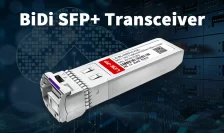
This guide clarifies the differences between soldered SFF and 1x9 transceiver form factors. Learn their specs, applications, and how to choose for your network.
ASK Modulation transmits digital data by varying a carrier wave's amplitude, offering a simple, cost-effective solution for basic digital communication systems.
Discover what an HDD (Hard Disk Drive) is, how it works, and its role in computing. Learn its functions, types, advantages, and how it compares with SSD storage.
Discover what RAM (Random Access Memory) is, how it works, and why it matters for system performance. Learn its functions, types, and role in modern computing.
Learn what a Network Interface Card (NIC) is, its functions, and types. Discover how NICs enable connectivity in computers, servers, and networking equipment.
Discover how optical modules (SFP, QSFP, CWDM) enable high-speed, long-distance communication in GPU clusters for AI training and HPC. Explore LINK-PP solutions for reliable cluster networking.
Frequency Division Multiple Access assigns each user a unique frequency band, enabling clear, simultaneous communication in phones, radios, and satellites.
Broadband is the internet service itself, while WiFi is the wireless technology that distributes it. Learn their differences and how LINK-PP’s optical transceivers enhance broadband performance.
Discover how optical transceivers power broadband networks by enabling high-speed fiber data, low latency, and scalable infrastructure with LINK-PP solutions.
explains how optical splitters enable FTTH, their types (FBT vs. PLC), key ratios, and how they integrate with LINK-PP optical modules for a seamless network.
Compare FTTH and FWA broadband technologies. Learn their differences in speed, cost, deployment, and use cases. Discover how LINK-PP SFP modules support both networks.
Discover the Decision Feedback Equalizer (DFE), the nonlinear technique essential for minimizing ISI. Learn how DFE improves bit BER in optics transceivers and long-haul data links.
Learn what FFE (Feed-Forward Equalizer) is, how transmit equalization works, and why FFE is essential for high-speed optical modules and SerDes signal integrity.
A wireless LAN (WLAN) connects devices like laptops and phones using radio waves, enabling flexible, cable-free networking in homes, schools, or offices.
Learn how the Continuous-Time Linear Equalizer (CTLE) dramatically improves signal integrity in SFP modules, effectively combating channel loss and maximizing link performance.
Understand TDCEQ, the critical PAM4 transmitter quality metric for modern optical modules. Learn how tdecq measures vertical eye closure and affects 50/100/400g module performance and compliance.
Learn what the EtherCAT Slave Controller (ESC) is and how it processes real-time frames, manages FMMU mapping, and enables high-speed industrial automation.
Learn what FMMU (Fieldbus Memory Management Unit) is and how it enables real-time EtherCAT communication through efficient memory mapping and on-the-fly data processing.
Discover the LQ‑SW40‑SR4C 40GBASE‑SR module: high-speed, low-power, QSFP+ optics for multimode fibre networks. Perfect for data centres and network upgrades.
Learn what hyperconverged infrastructure HCI is, how it compares with virtualization and dHCI, and when Nutanix, Sangfor, or SFP-based designs fit best.
Understand SFP+ 40km (10GBASE-ER) modules, including specs, SMF compatibility, and how to choose the right extended-reach optical transceiver for your network.